Decide what kind of help you want
AI Photo Book vs Human Photo Book Designer for Old Family Photos
The short answer
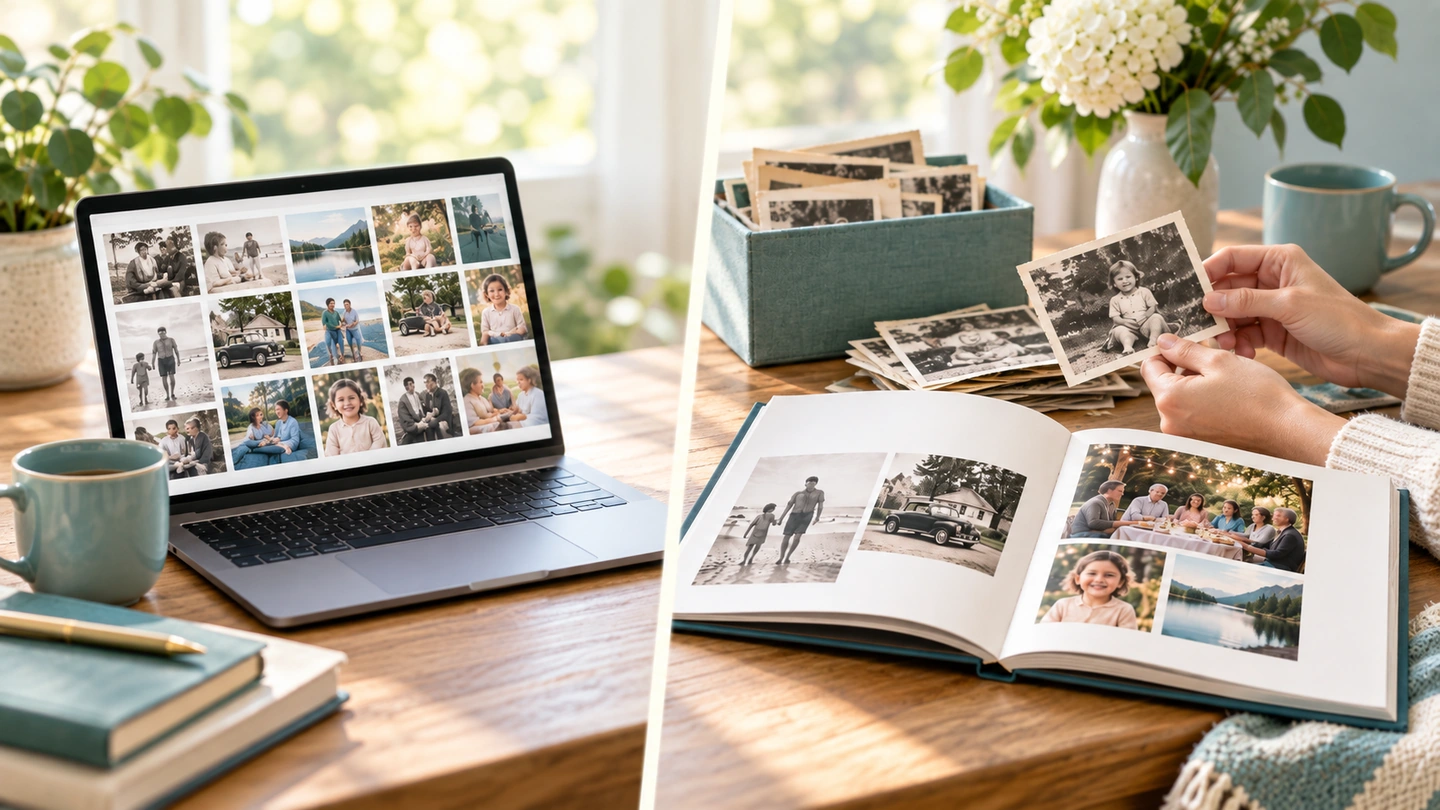
Automated photo-book tools are strongest when the main problem is volume: too many photos to sort, group, and lay out by hand.
A human design service is stronger when the main problem is judgment: deciding which pictures tell the story, how to balance people and events, and how much space each memory deserves.
For a 500–1,000-photo family project, the choice is often less about technology and more about which part of the job you would be happiest handing off.
Automation
Best when: the collection is huge and unsorted, you want a fast first draft, chronology helps, and repetitive layout work is the enemy.
Human design
Best when: the book is emotionally important, photo selection feels overwhelming, storytelling is complicated, or you want real revision conversations.
Flexible DIY
Best when: you enjoy the creative part and want strong tools without giving up control of the finished pages.
Where automation can save you work
Current services such as PastBook and Journi can organize very large sets and build layouts automatically. Journi is especially oriented toward chronology, dates, and maps. PastBook focuses on getting from a large photo set to a finished book with less manual sorting and layout work.
What the software still cannot know
An algorithm does not know which slightly blurry picture of a grandparent is emotionally priceless. You still need to review the result, catch mistakes, check names and dates, and make sure the photos the software favors are actually the ones your family cares about.
When human help may be worth paying for
Human design help matters most when someone needs to make subjective decisions, not just arrange boxes on a page. PikPerfect is the clearest example here: it offers paid photo-selection help and professional design with revisions.
The downside is straightforward: human help costs substantially more, and the process is usually slower than an automated first draft.
The middle ground: get software help and keep control
Mixbook sits between the two extremes. It provides templates and automation while giving you much more control over the final design. That makes sense if you enjoy the creative part but don't want to build every page from a blank canvas.
A few questions that make the choice easier
- Do I already know which 500 photos belong in the book?
- Do I care about strict chronological order?
- Are captions, dates, and family-history context important?
- Do I actually enjoy layout work?
- Would I rather spend more money or more time?
- Do I want a person or service making subjective design decisions, or do I want those decisions to stay with me?
Choose automation when your main enemy is volume.
Choose a human designer when your main enemy is decision fatigue.
Choose flexible DIY when you want to make the creative decisions yourself.